A HUMAN-CENTERED PRACTICE
Understanding people.
Surfacing assumptions.
Moving forward
with confidence.
Ritual Reason helps organizations make better product and business decisions by combining customer understanding, research, and structured collaboration.
Make the uncertainty visible.
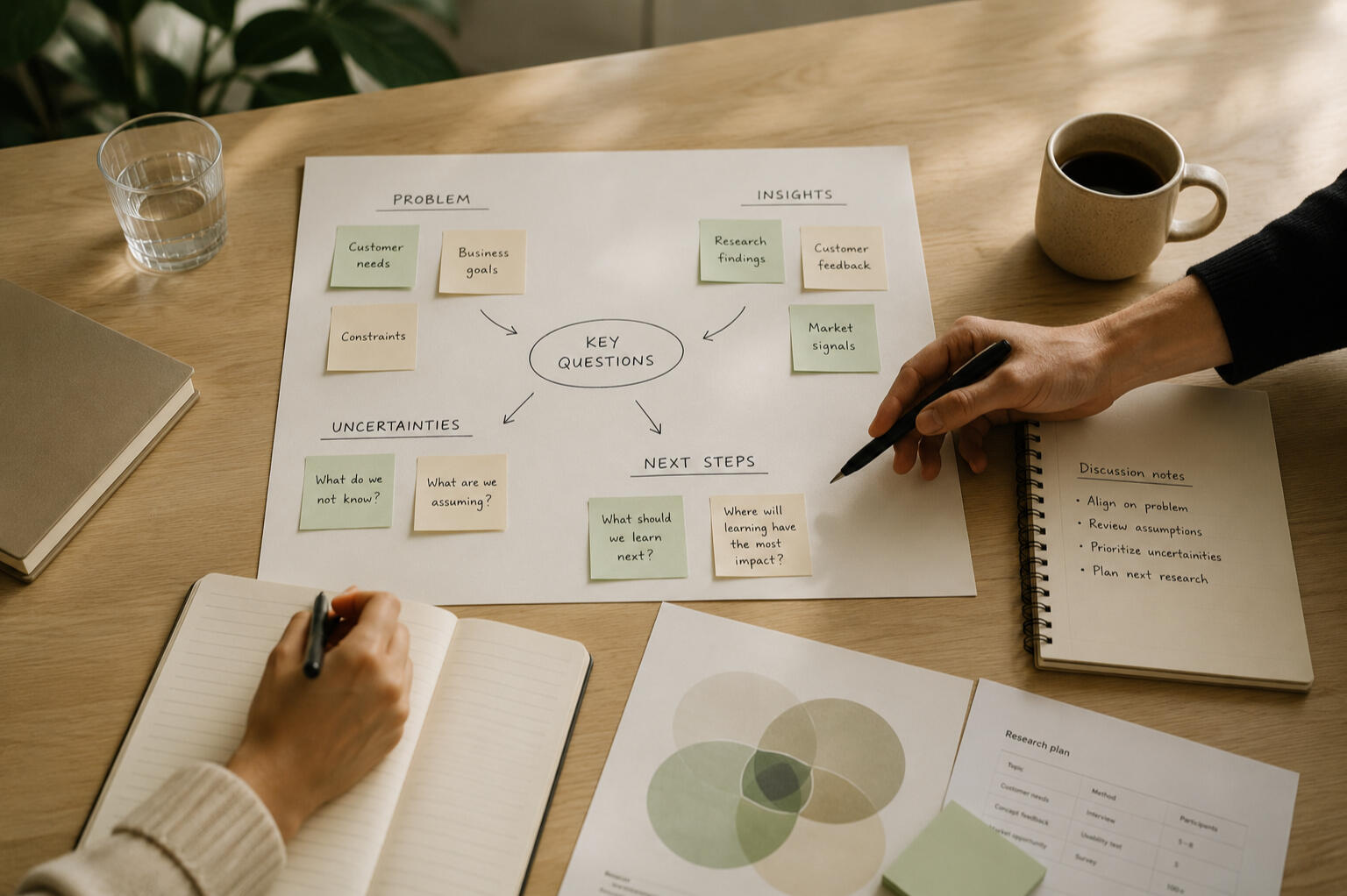
Important decisions are rarely shaped by a single source of truth. Customer needs, business goals, stakeholder perspectives, existing research, and organizational assumptions all influence the path forward. The challenge is understanding what is already known, what remains uncertain, and where additional research or learning will create the most value.
RITUAL REASON HELPS TEAMS
01
Understand people and the problems they face
02
Surface assumptions and hidden risks
03
Focus learning where it creates the most value
04
Build confidence before committing resources
HOW WE WORK
The Rituals
Ritual Reason's work is structured around four practices that help teams navigate uncertainty and move forward with greater confidence. Each practice can stand alone or be combined based on the needs of the organization.
01
Ritual Assessment
Understand how decisions are being made today.
Assess where information comes from, how it's interpreted, and where understanding breaks down so teams can see what's driving decisions and strengthen how they're made over time.
EXAMPLE ACTIVITIES
Stakeholder Interviews · Information Flow Analysis · Decision Mapping
02
Ritual Alignment
Align on the problem, the customer, and the opportunity.
Bring together customer insights, stakeholder perspectives, and existing knowledge to make assumptions, risks, priorities, and success criteria explicit before decisions are made.
EXAMPLE ACTIVITIES
Problem Framing · Assumption Mapping · Defining Success Metrics
03
Ritual Planning
Focus learning on the questions that matter most.
Identify what is already known, where the most important gaps remain, and what needs to be learned before moving forward.
EXAMPLE ACTIVITIES
Insight Inventories · Decision-Risk Assessment · Research Prioritization
04
Ritual Enablement
Build the capability to make evidence-informed decisions.
Support teams in conducting research, interpreting evidence, and applying insight so research becomes part of how decisions are made.
EXAMPLE ACTIVITIES
Mixed-Methods Research · Embedded Coaching · Workshop Facilitation
WHAT CHANGES
Fewer resets. Clearer decisions. More consistent forward progress.
Assumptions and risks are surfaced early, instead of becoming costly surprises later
Teams move forward with a shared understanding of the problem, the customer, and the evidence informing decisions
Time and resources are focused on answering the questions that matter most
Teams build stronger habits for gathering, interpreting, and applying customer understanding
ABOUT RITUAL REASON
Ritual Reason exists to help organizations make better decisions when the path forward isn't clear. Drawing from research, facilitation, and product strategy, we help teams create shared understanding, reduce uncertainty, and move forward with confidence.
We believe:
Shared understanding leads to better decisions
Assumptions should be surfaced before they become costly
Learning should reduce uncertainty, not create more noise
Capability matters more than dependency
Diverse perspectives strengthen outcomes
Founded by Courtney Barton
A researcher and strategist who has spent her career helping organizations understand customers, evaluate opportunities, and navigate complex decisions where the path forward wasn't clear.
© 2026 Ritual Reason LLC. All rights reserved.
Understanding people. Moving forward together.

A researcher and strategist who helps organizations make decisions when the path forward isn't clear.
Throughout her career, Courtney has worked across market research, UX research, product strategy, and consulting, helping organizations understand customers, evaluate opportunities, and navigate uncertainty. Her work has spanned emerging technologies, new product development, organizational transformation, and other situations where there was no established playbook.She has helped organizations build customer understanding, evaluate launch readiness, develop new approaches to generating and applying insight, and strengthen internal research capability. Her experience includes work with organizations such as Meta, Amazon, Microsoft, Google, and Sherwin-Williams.Working alongside product, design, and business leaders, Courtney observed a recurring challenge: organizations often had access to research, data, and expertise, but struggled to align around what it meant, what assumptions remained, and what should happen next.
Ritual Reason was created to help address that gap.Through research, facilitation, and collaborative working sessions, Courtney helps teams understand how decisions are made, where assumptions and uncertainty exist, and what stands in the way of alignment. The goal is not simply to generate more information, but to create the shared understanding needed to move forward with greater confidence.
© 2026 Ritual Reason LLC. All rights reserved.
Understanding people. Moving forward together.
PRACTICE IN ACTION
Examples of Work
Examples of how research, alignment, and learning have informed important product and business decisions.
01 / From Assumptions to Understanding
Evaluating a Cross-Platform Sharing Experience
Focus Areas
Stakeholder Alignment
Assumption Mapping
Research Planning
Opportunity Evaluation
Impact
Shared Understanding
Refined Product Direction
Reduced Product Risk
SITUATION
A team was developing a new feature as part of a broader initiative to increase awareness of an emerging platform. Success metrics had already been defined, and implementation was underway, but many of the assumptions connecting the solution to the desired outcome remained unexplored.
CHALLENGE
The initiative depended on assumptions about customer behavior, content sharing, discovery, and adoption. If those assumptions were wrong, the team risked investing in a feature that failed to achieve its intended business outcome while creating friction for both existing and new audiences.
APPROACH
Stakeholders aligned around the assumptions, risks, and unknowns shaping the initiative. Existing evidence was reviewed, key knowledge gaps were identified, and learning efforts focused on the questions most likely to influence future decisions. As understanding evolved, insights were used to evaluate both the proposed experience and the broader assumptions supporting it.
OUTCOME
Several assumptions required refinement. While people were already sharing experiences, the proposed sharing mechanism was not necessarily the preferred path. Additional barriers related to context, discovery, and participation emerged, shifting the conversation from validating a feature to understanding the broader conditions required for adoption.
02 / Defining a New Market Opportunity
Building a Customer-Informed Product Strategy
Focus Areas
Research Planning
Opportunity Evaluation
Customer Understanding
Strategic Alignment
Impact
Clear Market Focus
Expanded Product Vision
Prioritized Product Roadmap
Shared Strategic Direction
SITUATION
A rapidly changing shift toward remote work created new opportunities for collaboration technology, but it also introduced significant uncertainty. Existing solutions were designed primarily for office environments, while customer expectations, workflows, and social norms for remote work were still evolving.A team needed to determine where to focus investment, which customer needs mattered most, and what role a new product could play within an emerging category.
CHALLENGE
The opportunity space was broad. The product could serve enterprise organizations, small businesses, home offices, meeting rooms, or individual professionals. While the technology was capable of supporting a wide range of use cases, resources were limited and not every opportunity could be pursued.Without a clear understanding of customer priorities, there was a risk of building broadly while creating limited differentiation.
APPROACH
Customer needs, market dynamics, competitive offerings, and future opportunities were evaluated to identify where the product could create meaningful value.The work helped establish a shared understanding of customer priorities, clarify which needs were underserved, and create alignment around long-term product direction. Opportunity areas were mapped against existing plans, helping teams identify differentiators, gaps, and areas of strategic focus.Insights informed both near-term product decisions and longer-term vision work, creating a common framework for evaluating future investments.
OUTCOME
The work helped transform a broad set of possibilities into a more focused product strategy.Rather than remaining narrowly focused on video calling, the product vision expanded to support a wider range of remote work and connection needs. The resulting strategy informed roadmap prioritization, shaped onboarding and customer experiences, and helped teams align around where the product could provide the greatest value over time.The result was a clearer understanding of the opportunity, stronger alignment across stakeholders, and a more intentional path for future product development.
© 2026 Ritual Reason LLC. All rights reserved.
Understanding people. Moving forward together.